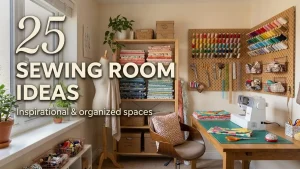
A great sewing room isn’t about having endless square footage, it’s about building a system that actually works for how you create.
Whether you’re sorting through real spaces that sewists have styled and organized themselves, or picturing fresh setups built for small apartments and awkward nooks, this list covers the full range of what a craft space can become.
You’ll find fabric storage solutions that double as decor, cutting stations tucked into window seats and closets, and small details like thread wrapped clothespins that make a bigger difference than you’d expect.
Some ideas lean collected and maximalist, filled with vintage machines and color. Others stay clean and minimal, built around clear bins and open shelving.
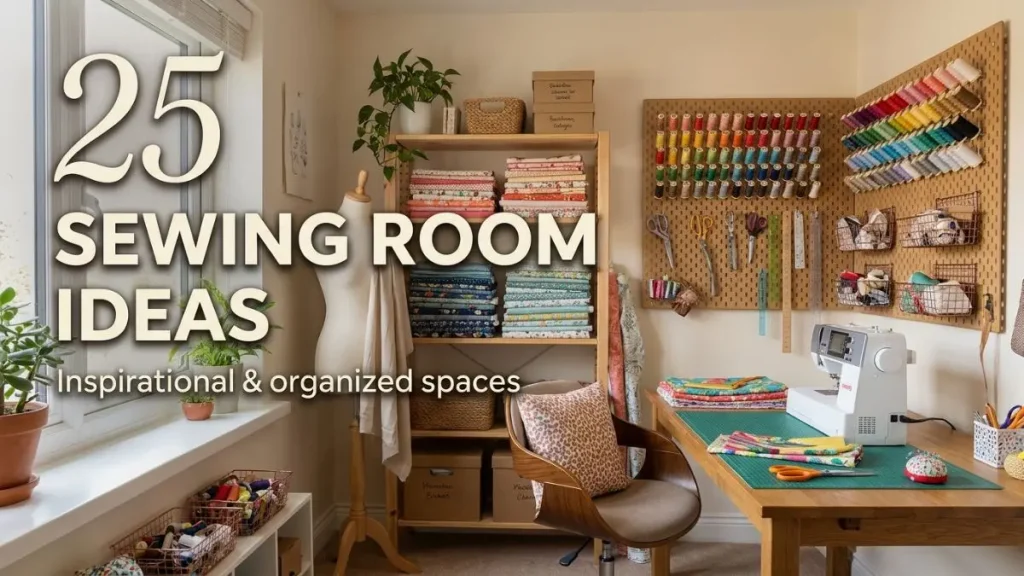
There’s no single right way to set up a sewing space, only the version that fits your habits, your square footage and the projects you actually finish.
Scroll through all 25 sewing room ideas for inspiration you can pull pieces from, mix together, or copy outright for your own room.
1. A Collector’s Corner Bursting With Color
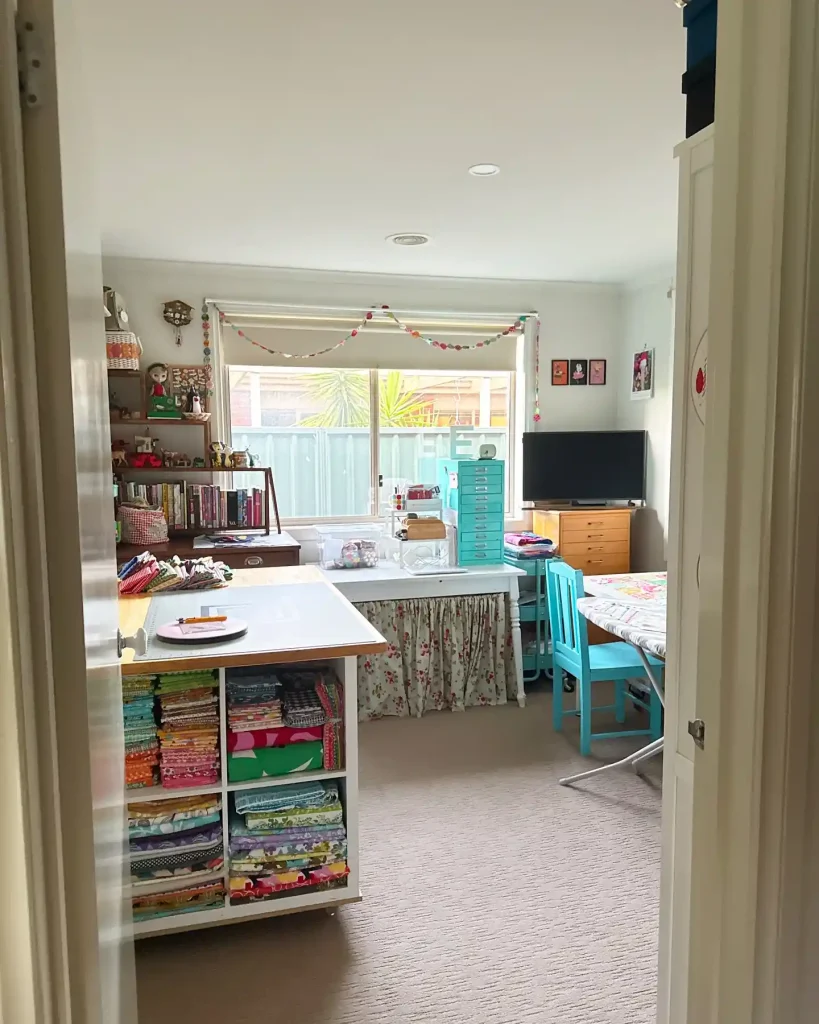
This sewing room leans maximalist in the best way, with a bookshelf of craft books and vintage sewing trinkets stacked beside a window strung with a pastel pom pom garland.
A turquoise multi drawer filing cabinet anchors the far table, which sits skirted in a cherry print fabric.
Open cubby storage on wheels holds folded fabric sorted loosely by color, with a rotary cutting mat doubling as a work surface on top.
A teal painted chair and a mini ironing station fill out the back corner. Nothing here is matched on purpose, and that’s exactly the charm, every surface tells you this room gets used daily.
2. The Clean-Lined Fabric Library Setup
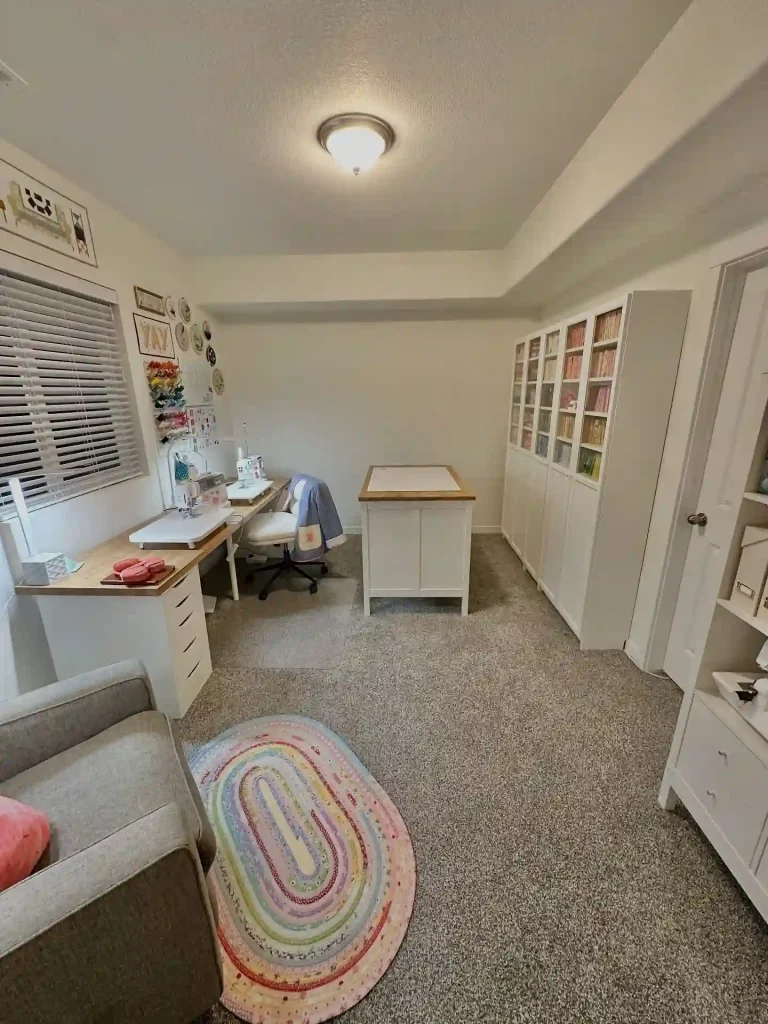
Neutral and quiet, this layout trades clutter for a built-in wall of glass front cabinets where fabric bolts are organized by color so the whole wall reads like a gradient.
A simple white island with a butcher block top sits center room for cutting, with nothing on it but the mat itself.
Against the window, two machines share one long white desk with a ribbon organizer taped to the wall beside it.
A handmade rainbow jelly roll rug grounds the gray carpet, and a soft gray armchair gives the room somewhere to sit that isn’t the sewing chair.
| Storage | Glass front cabinets, fabric sorted by color |
| Work surface | White island, wood top |
| Softening touch | Handmade rainbow rug |
3. A Boho Courtyard Sewing Nook
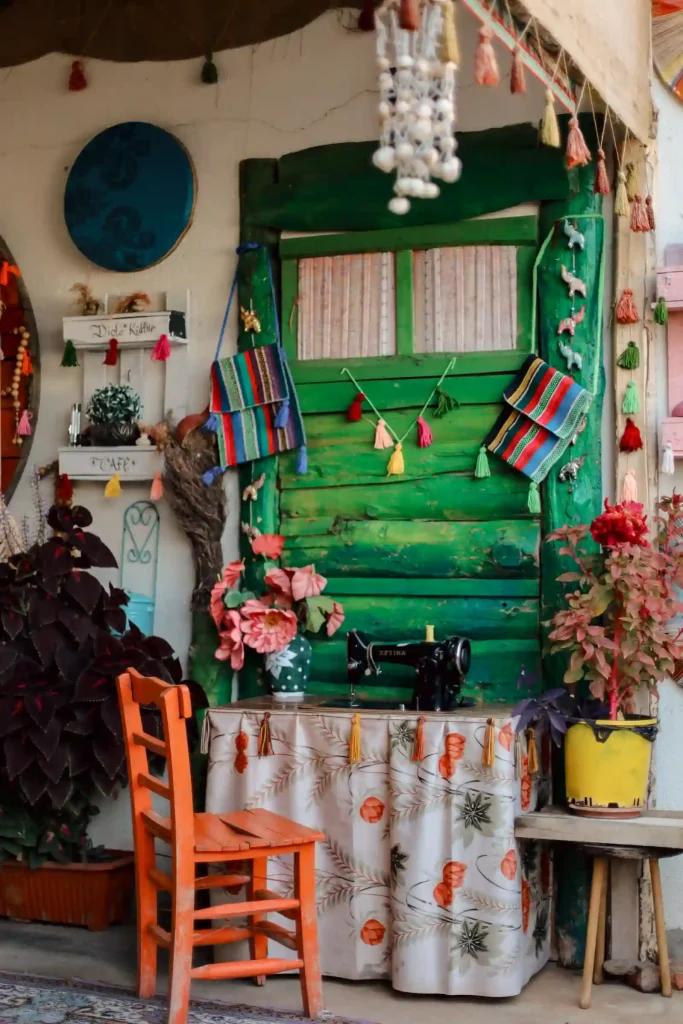
Set outdoors against a weathered green door, this vignette turns a black vintage machine into the centerpiece of a styled corner rather than a working station.
Tassels in rust, mustard and blush hang from every edge, and a macrame shell garland drapes overhead like a chandelier.
The machine sits on a floral printed table skirt, flanked by pink florals in a speckled vase and a yellow painted bucket planter.
An orange wooden chair pulls the whole palette together against the teal round mirror on the wall. It reads more styled photo backdrop than functional room, which makes it a great mood reference for color pairing.
See how to organize sewing rooms for better work progress.
rustic green backdrop, tasseled trim, a vintage machine styled as decor
4. Stacked Vintage Machines as Wall Art
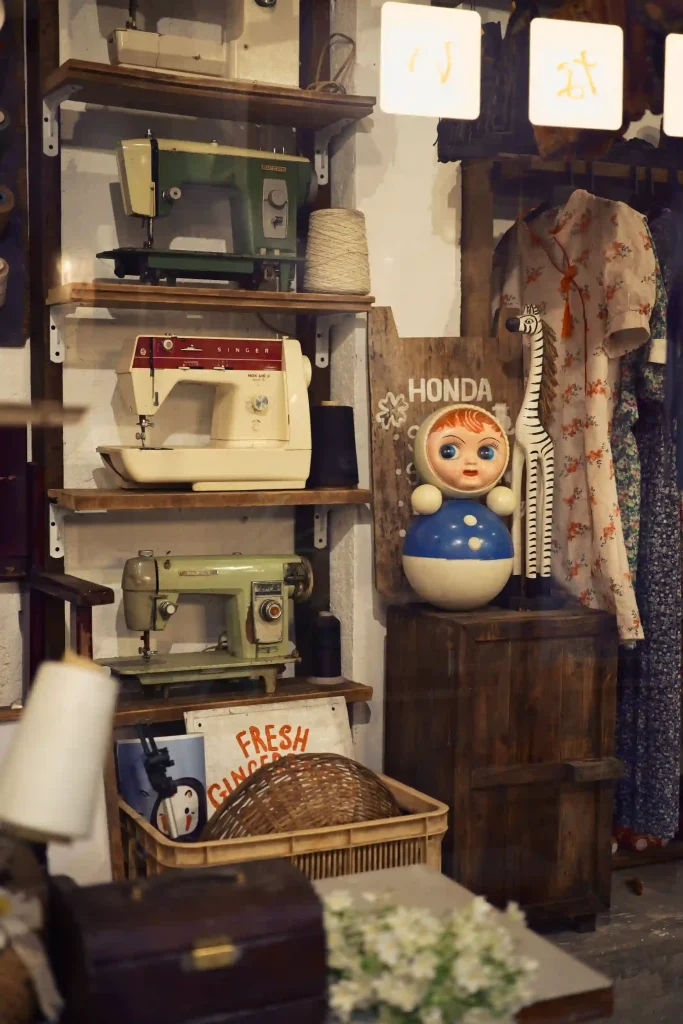
Three vintage machines line a bracketed wood shelf here, a green bodied model on top, a cream and red Singer in the middle, and a sage green model below, each paired with its own spool of thread or twine.
Warm overhead lighting gives the whole shelf a golden cast. Beside it, a wooden crate holds a woven basket, and a floral vintage dress hangs just out of frame.
Nothing is plugged in or staged for use, these machines exist purely as a collected display. For anyone short on floor space, it’s proof that even non-working machines earn their keep as shelf decor.
Top shelf: green bodied machine, twine spool
Middle shelf: cream and red Singer
Bottom shelf: sage green machine, woven basket
5. A Mood Board Dress Form Display
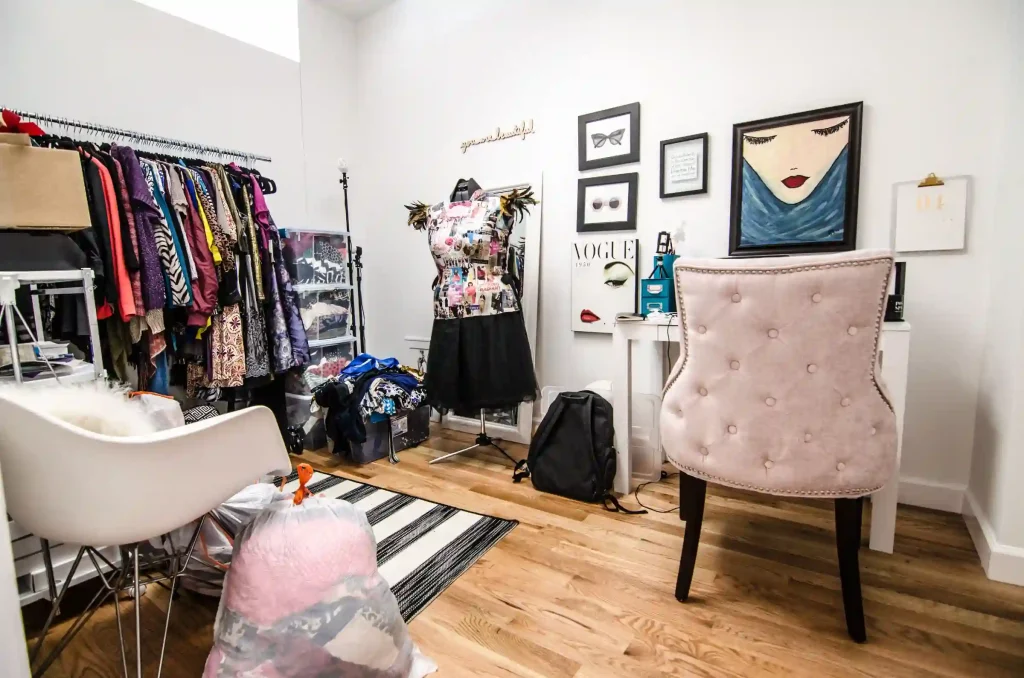
Part workspace, part inspiration wall, this room is built around a dress form collaged head to waist in magazine clippings and fashion headlines, finished with feather accents at the shoulders.
A garment rack packed with colorful pieces runs along one wall, while a gallery grouping of sunglasses sketches, a Vogue cover print and a face painting fills the opposite side.
A tufted blush chair sits beneath the artwork, and a slim white desk holds a small camera and storage bins. Clothing bags and bins still waiting to be sorted sit on the floor, giving the space an honest, mid project feel.
Mood Board Corner
Collaged dress form, gallery wall, garment rack
6. Where Sketches Meet Fabric Swatches
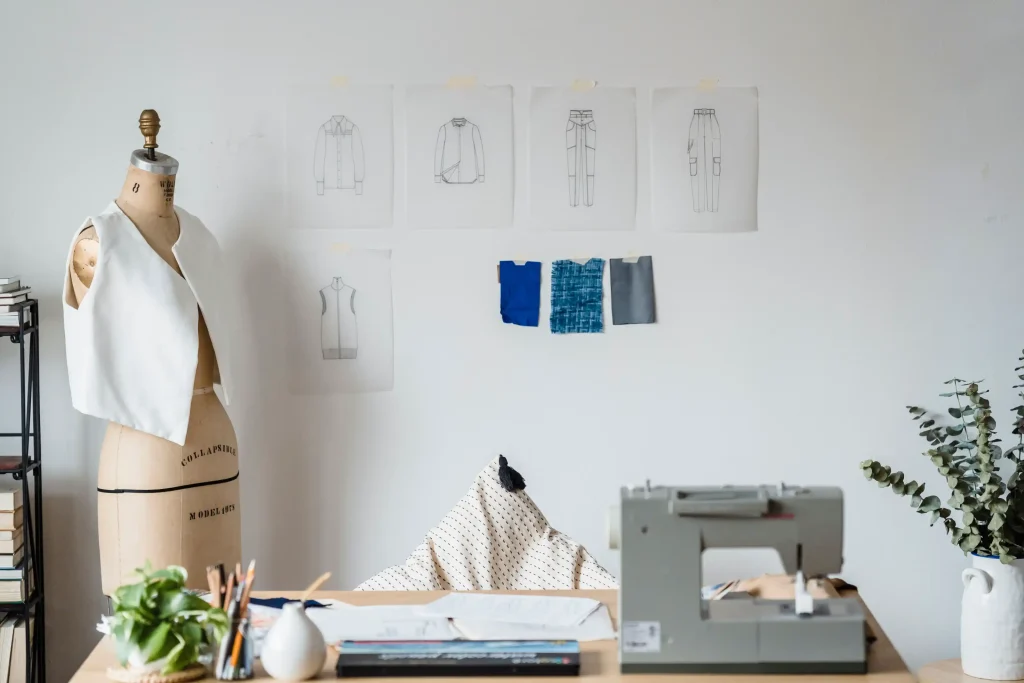
A dressmaker’s mannequin wears a half finished white vest here, its toile still pinned together, standing beside a taped up wall of flat sketches showing shirts, trousers and a vest in progress.
Three fabric swatches in cobalt, teal weave and charcoal are pinned beneath the drawings like a working palette.
A gray sewing machine sits on a light wood desk below, surrounded by sketchbooks, a pencil cup and a pear shaped ceramic vase.
Eucalyptus stems in a white pitcher soften the otherwise technical corner. It’s a workspace clearly built around the design process, not just the stitching.
7. Pegboard Walls That Keep Every Tool Visible
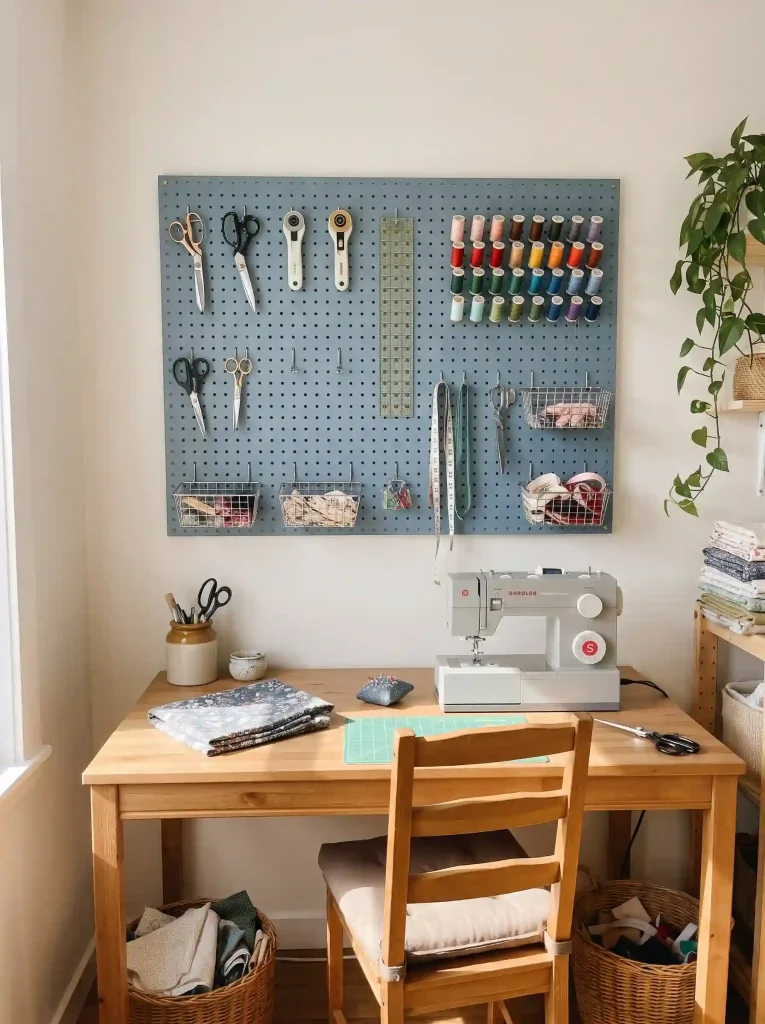
A full pegboard wall turns scissors, rulers, tape measures and spools into part of the decor instead of clutter in a drawer. Hooks hold tools at arm’s reach above the sewing table, while small baskets clipped into the grid catch bobbins and clips that would otherwise roll away.
The beauty of this setup is how customizable it stays, since hooks move around as projects change.
Paint the board a soft dusty blue or leave it natural wood for warmth. It works in a closet sized nook just as well as a full room, making it one of the most flexible storage upgrades a sewing space can get.
8. A Closet Reimagined Into a Fold-Out Studio
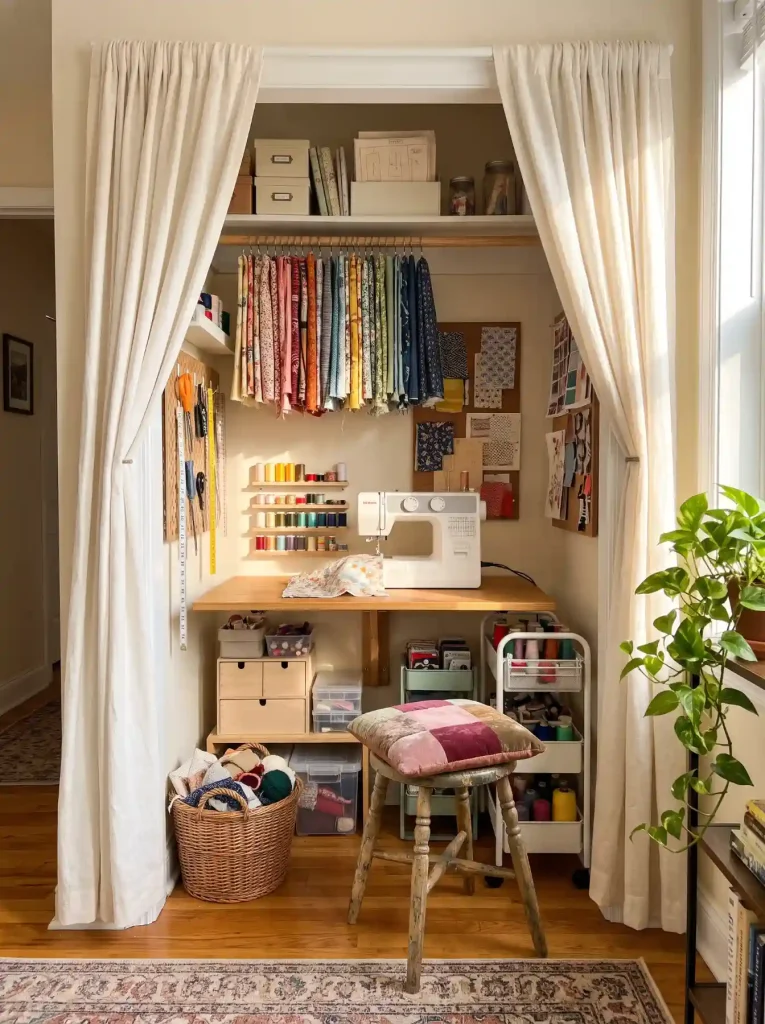
Not every sewing space needs its own room.
Here, a standard closet has its doors removed and its interior rebuilt with a drop down shelf that becomes a sewing table when needed and folds flat when it’s not.
Thread spools line small drawers beneath, while a slim rod above holds fabric on hangers instead of folded stacks. S
oft curtains in place of doors keep the whole setup hidden from the rest of the house. This idea works especially well in apartments or guest rooms, proving that a dedicated craft room isn’t a requirement for staying organized and productive.
Before
Empty closet, wasted space
After
Fold-out table, curtain doors
9. Spool Ladder Shelving as a Vertical Thread Display
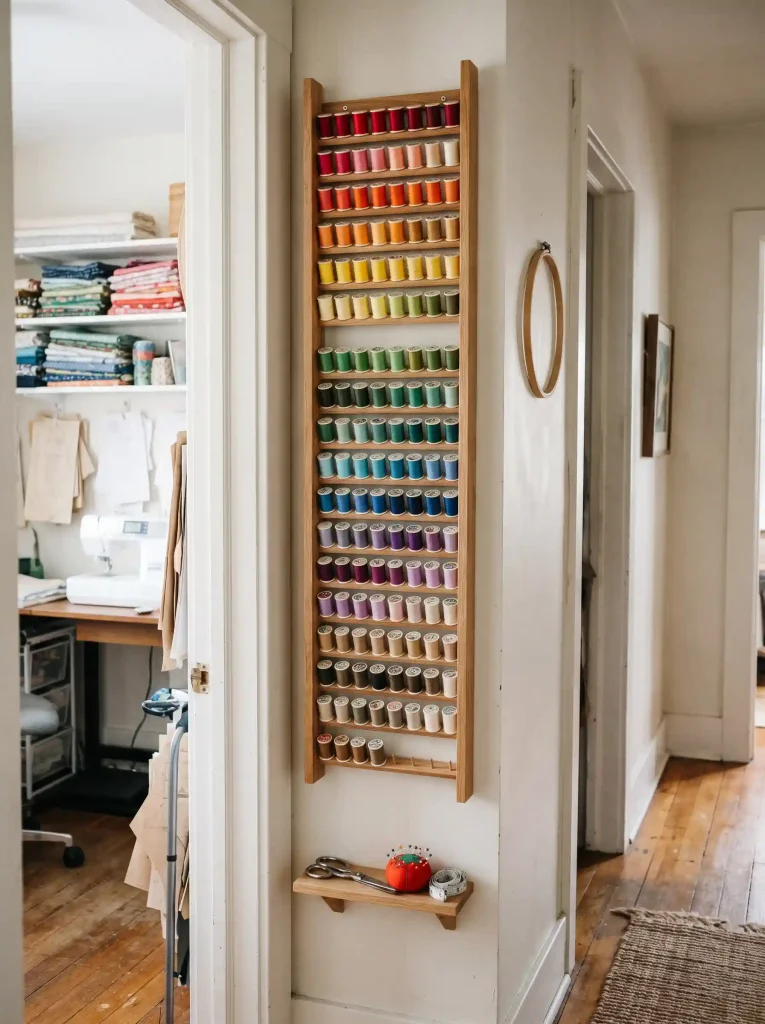
When floor space runs short, thread storage can climb the wall instead. A narrow ladder shelf mounted vertically holds spools stacked by color from top to bottom, creating a gradient effect that doubles as both storage and art.
Each shelf is shallow, just deep enough for one row of spools, which keeps the whole piece slim enough for a hallway or the back of a door. Below it, a small shelf holds scissors and a pin cushion for quick access.
It’s a simple build that turns an often overlooked supply into one of the room’s prettiest features.
thread sorted by color, floor to ceiling
10. Built-In Window Seat Doubling as a Cutting Station
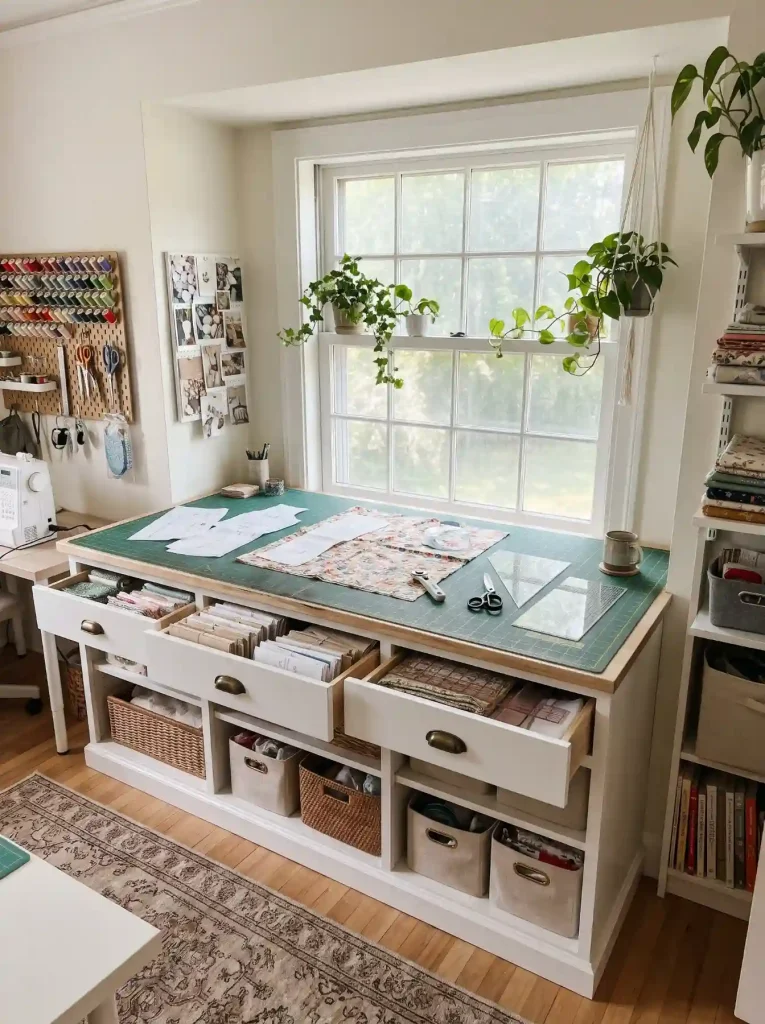
A deep window seat gets rebuilt into a cutting table by topping it with a hard surface at standing height, letting natural light fall directly onto fabric while it’s measured and marked.
Storage drawers underneath the seat hold patterns, pins and rulers, keeping the whole setup self contained.
A cushion tucked into one end means the space still works for sitting and hand stitching when the cutting mat isn’t in use.
This dual purpose build makes the most of an awkward nook that would otherwise sit empty, and the window light alone makes it worth the effort.
window seat cutting station
storage drawers below, natural light above
11. Labeled Bins That Turn Fabric Into a System
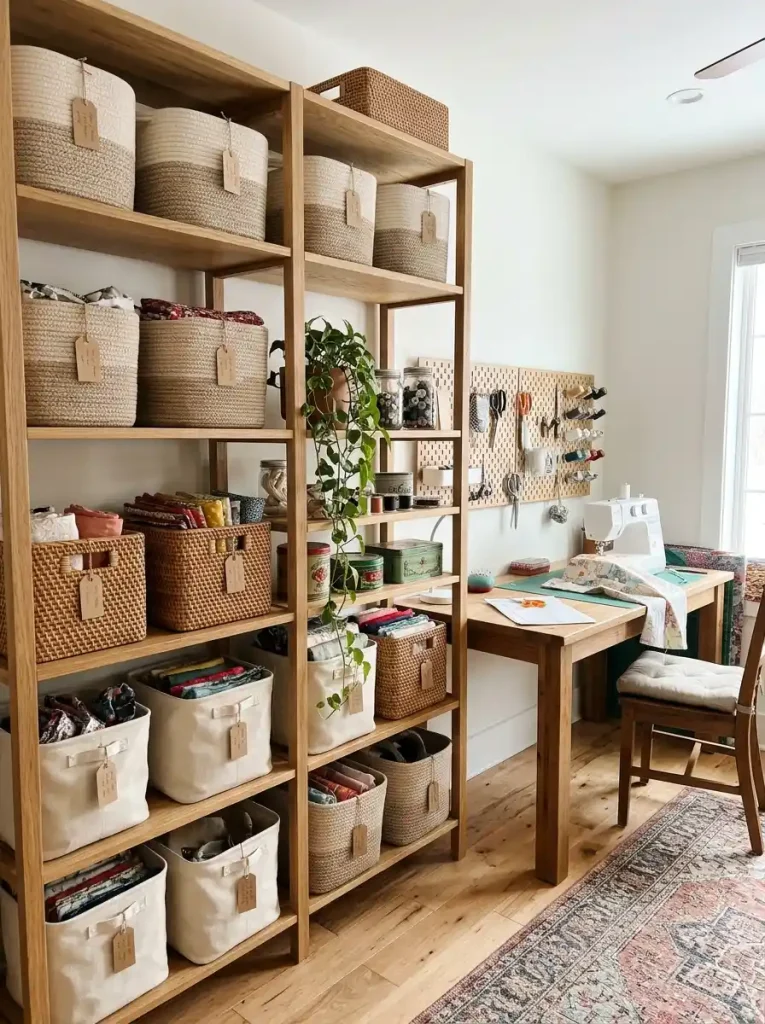
Open shelving filled with matching labeled bins takes fabric scraps, notions and half finished projects out of their usual chaos and gives each category its own home.
Labels written by hand or printed on simple tags mean nothing gets lost searching through unmarked piles.
The bins themselves stay neutral in tone so the fabric and trims inside provide all the color.
This kind of system works in any size room, scaling up with more bins or down with just a few, and it keeps a space looking tidy even mid project, which matters more than people expect.
scraps
notions
trims
patterns
zippers
projects
12. Clipped Pattern Wall Beside a Sunlit Corner Desk
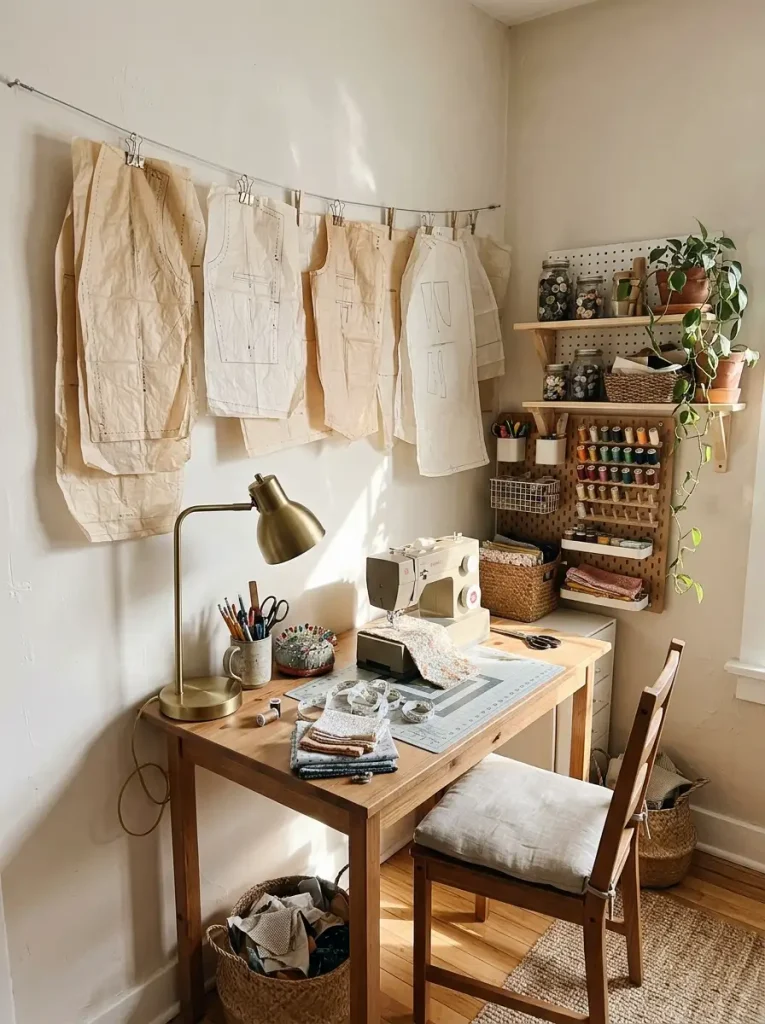
Paper patterns get their own display system here, clipped to a wire strung across the wall above a corner desk so each piece stays flat, visible and easy to grab mid project.
The desk below sits angled into the corner to catch window light from two sides, with just a machine, a small lamp and a cup of pens on top.
Nothing is hidden in drawers because everything in use that week hangs where it can be seen. It’s a setup built for someone juggling multiple projects at once, who needs the current pattern pieces within arm’s reach rather than filed away.
pattern pieces clipped and visible above a sunlit desk
13. A Rolling Cart That Moves Between Stations
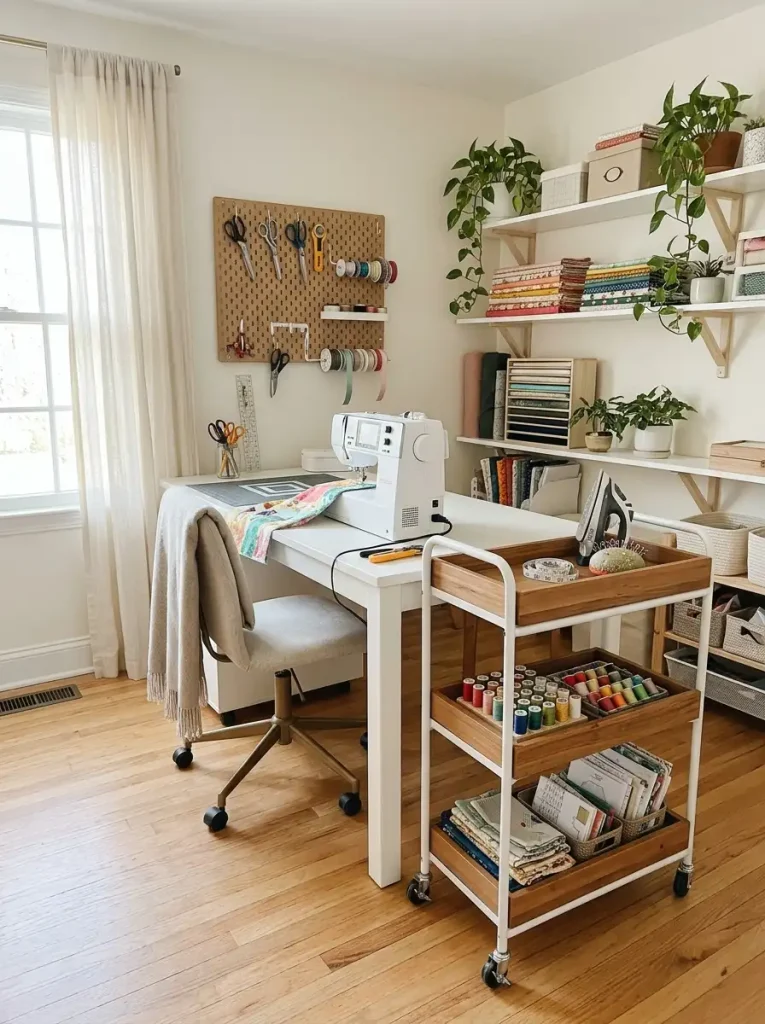
Keeping a sewing setup flexible sometimes means putting it on wheels.
A slim three tier rolling cart holds thread, scissors and a small iron on one level, pattern weights and pins on another, leaving the bottom tier open for whatever project is active that day.
Parking it beside the machine turns it into a side table, then rolling it against the wall clears the floor instantly when the room needs to double as something else.
Renters and small space sewists get the most out of this idea, since nothing here requires drilling into a wall or committing to a fixed layout.
+ pins
+ clips
project
14. Mason Jars Turn a Windowsill Into Thread Storage
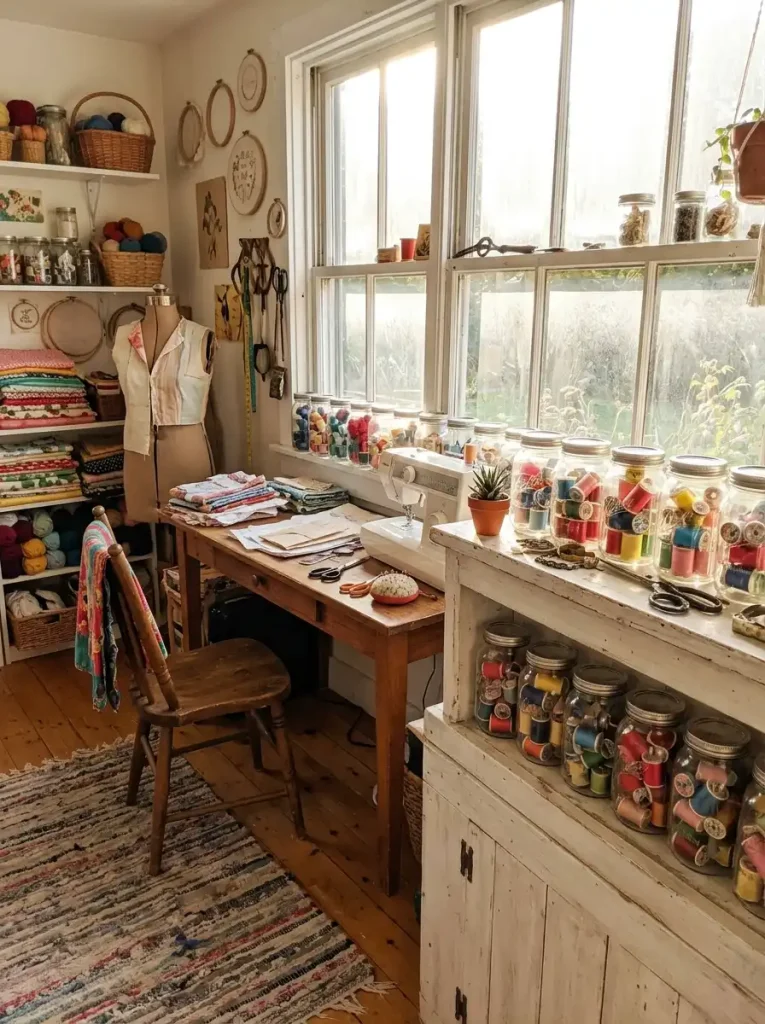
Lined up along a sunny sill, clear mason jars filled with thread spools catch the light and sort it by color at the same time, no cabinet required.
Each jar holds just enough spools to stay organized without tipping over, and the glass keeps everything visible without a single label.
This idea costs almost nothing and uses space that would otherwise sit empty, making it one of the easiest upgrades on this list. Swap jar sizes to fit wider sills, or group them in twos and threes if the window is narrow, the effect still reads as a tiny rainbow display.
15. A Hanging Pocket Organizer for Scraps and Notions
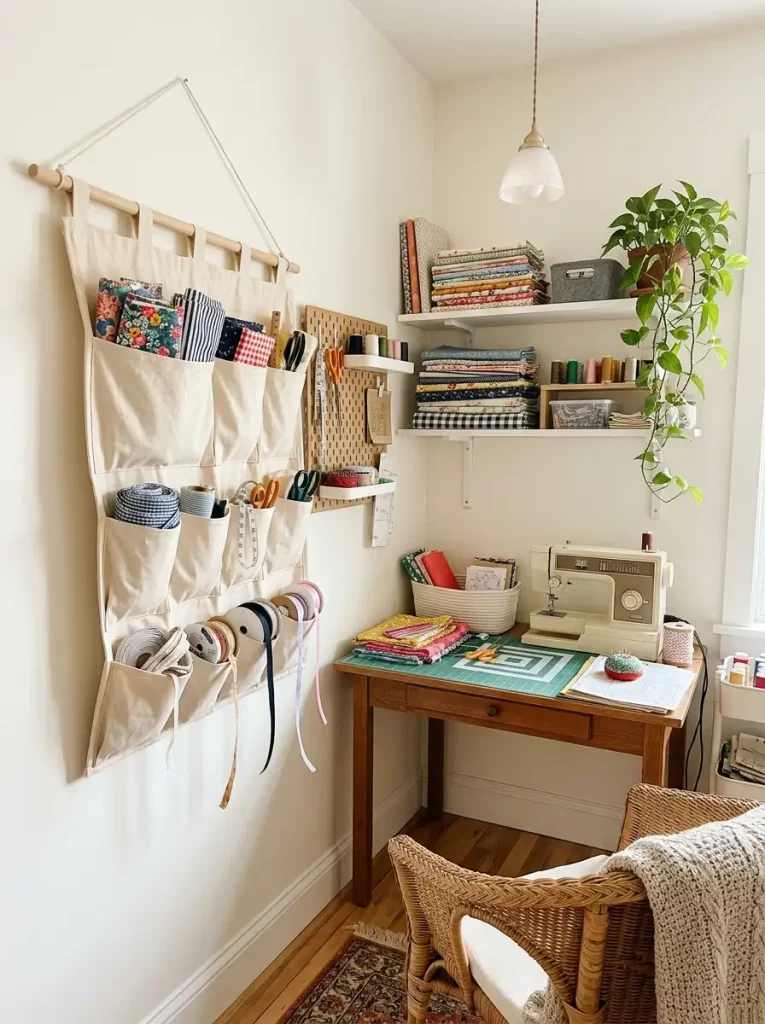
Mounted flat against an open wall, a canvas pocket organizer gives loose scraps, elastic and bias tape a vertical home instead of a drawer where they’d tangle.
Each pocket stays open and shallow so contents stay visible at a glance, and the whole piece rolls up for storage if the wall is needed for something else later.
Sewing specific versions come with clear vinyl pockets, but any sturdy fabric pocket organizer works just as well. For anyone who sews often and hates digging through bins, this keeps the small stuff sorted without taking up a single inch of surface space.
16. An Old Dresser Becomes the Notions Station
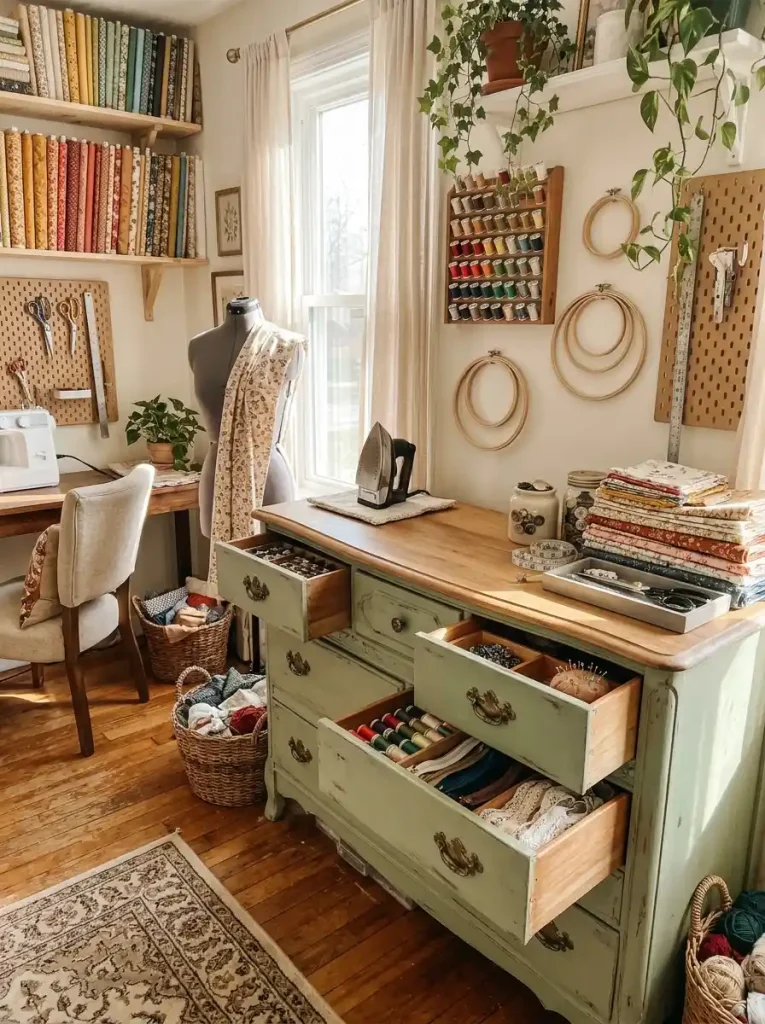
Rather than buying new storage, a secondhand dresser gets repainted and repurposed to hold every small notion a sewing room needs. Top drawers take pins, needles and bobbins in small divided trays, while deeper bottom drawers hold interfacing, zippers and elastic by the yard.
The flat top doubles as a spot for an iron or a small lamp when the main table is full. This approach keeps cost low and gives furniture that might otherwise be discarded a second purpose. Painting it to match the room’s palette is what makes it feel intentional rather than mismatched.
17. A Cork Wall for Collecting Pattern Inspiration
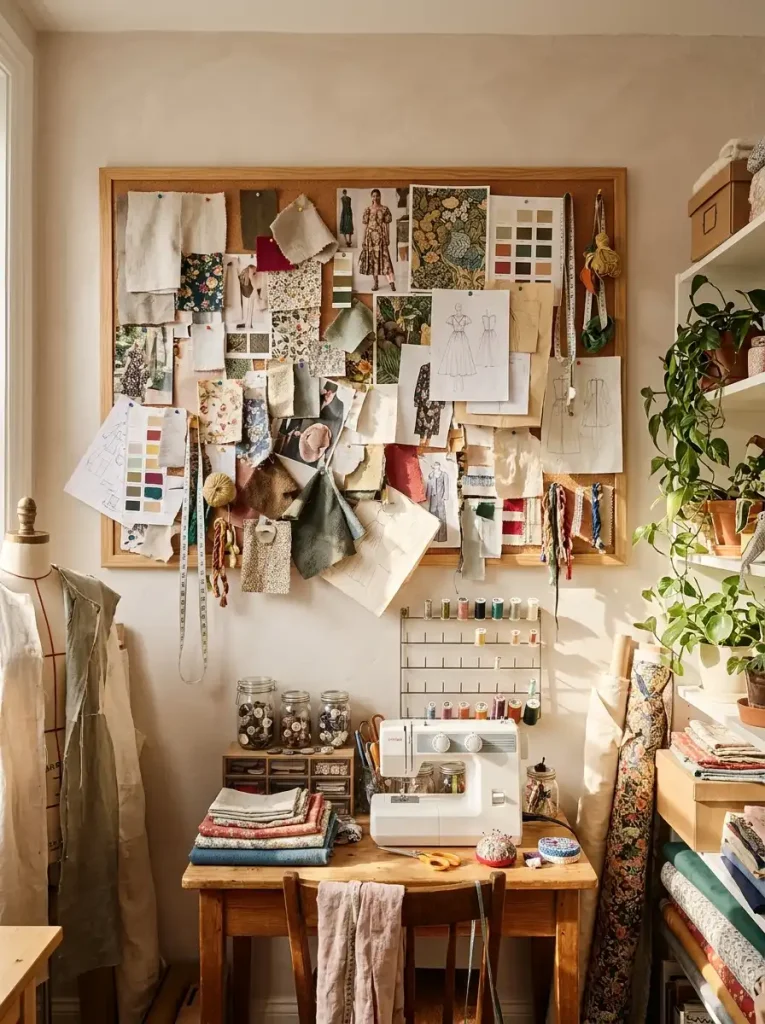
Pinned magazine clippings, fabric swatches and sketch ideas find a home on a cork board sized to fill most of one wall, turning the planning stage of sewing into something visible instead of buried in a folder.
Pieces get layered and rearranged as a project develops, so the board changes shape constantly rather than staying fixed.
A few photos of finished makes sit alongside the inspiration pulls, creating a loose timeline of what’s been done and what’s next. This setup works especially well for anyone who thinks visually and needs ideas in front of them rather than tucked away.
18. Fabric Bolts Hung From the Ceiling on a Dowel Rack
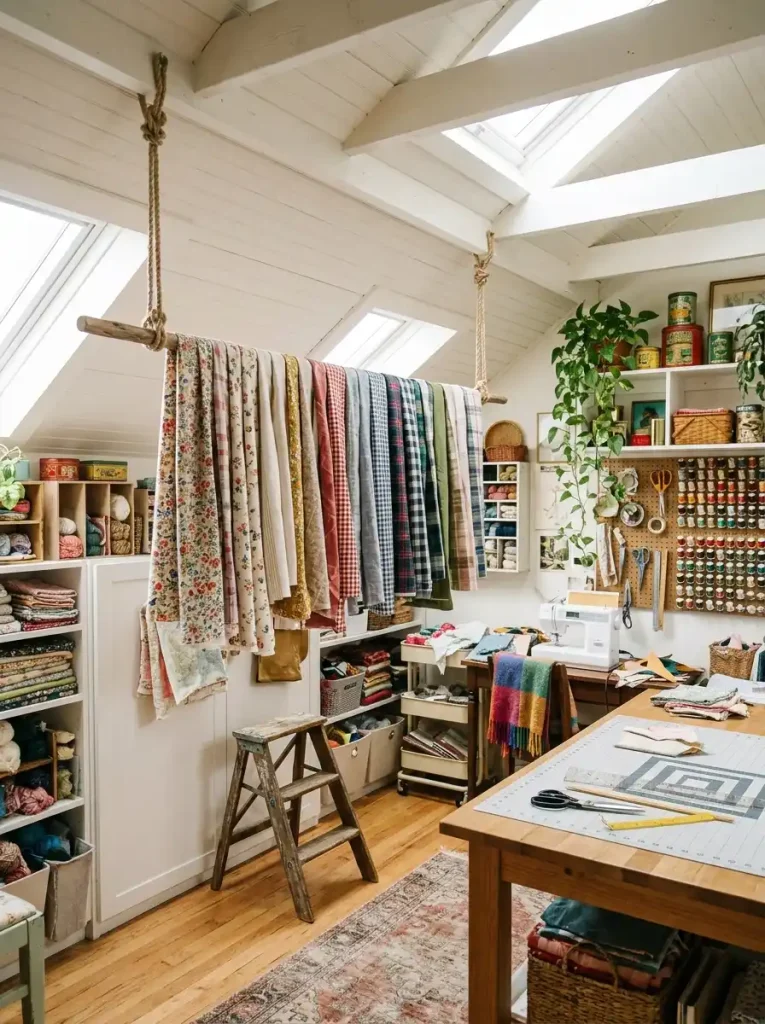
When shelf space runs out, fabric bolts can move overhead instead. A simple wooden dowel suspended by rope or chain holds bolts horizontally, keeping them out of the way while still visible and easy to pull down.
This works best for fabrics used less often, like special occasion or holiday prints, since reaching them takes a small step stool rather than a quick grab.
The visual effect alone makes it worth considering, rows of folded fabric hanging like a soft ceiling installation add color and texture to a room that might otherwise feel purely functional.
19. A Two-Tier Cutting Table With Hidden Storage Below
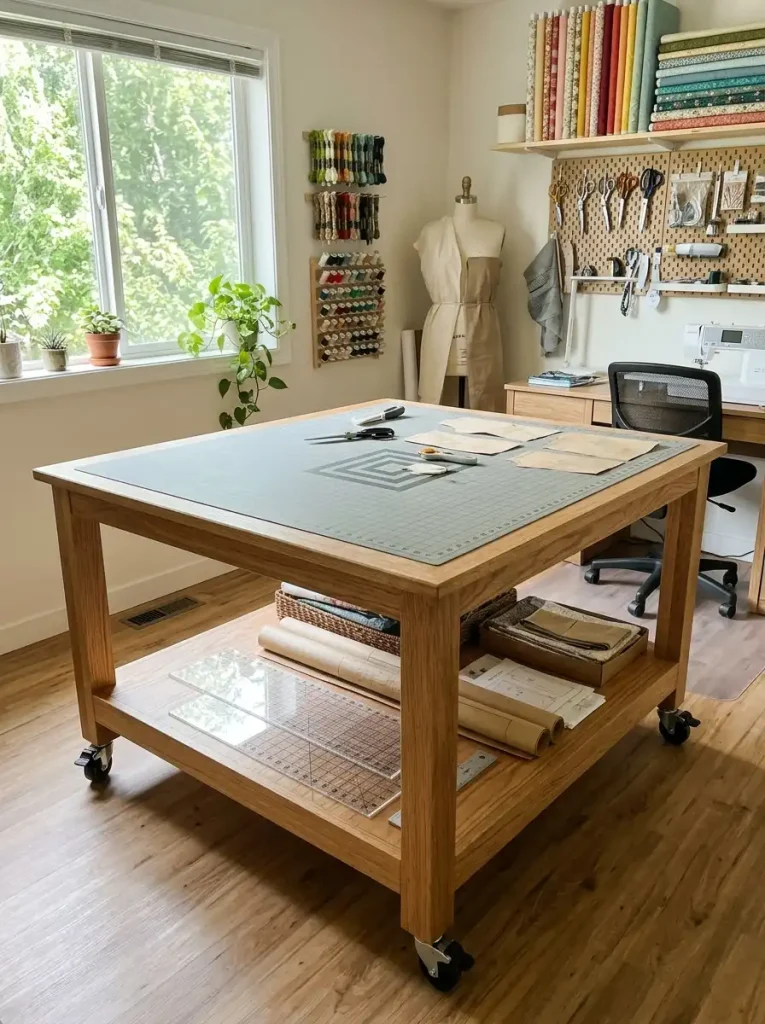
Built with a second lower shelf instead of open legs, this cutting table keeps rulers, cutting mats and pattern paper stored flat and within reach without cluttering the surface above.
The top stays clear for the actual cutting work, while the lower tier slides out slightly for easy access.
Caster wheels on the base let the whole table reposition itself depending on the project, sliding toward a window for better light or back against a wall when it’s not in use. It’s a practical build for anyone who cuts fabric often and wants dedicated storage built into the furniture itself.
20. A Fold-Down Wall Table for Micro Spaces
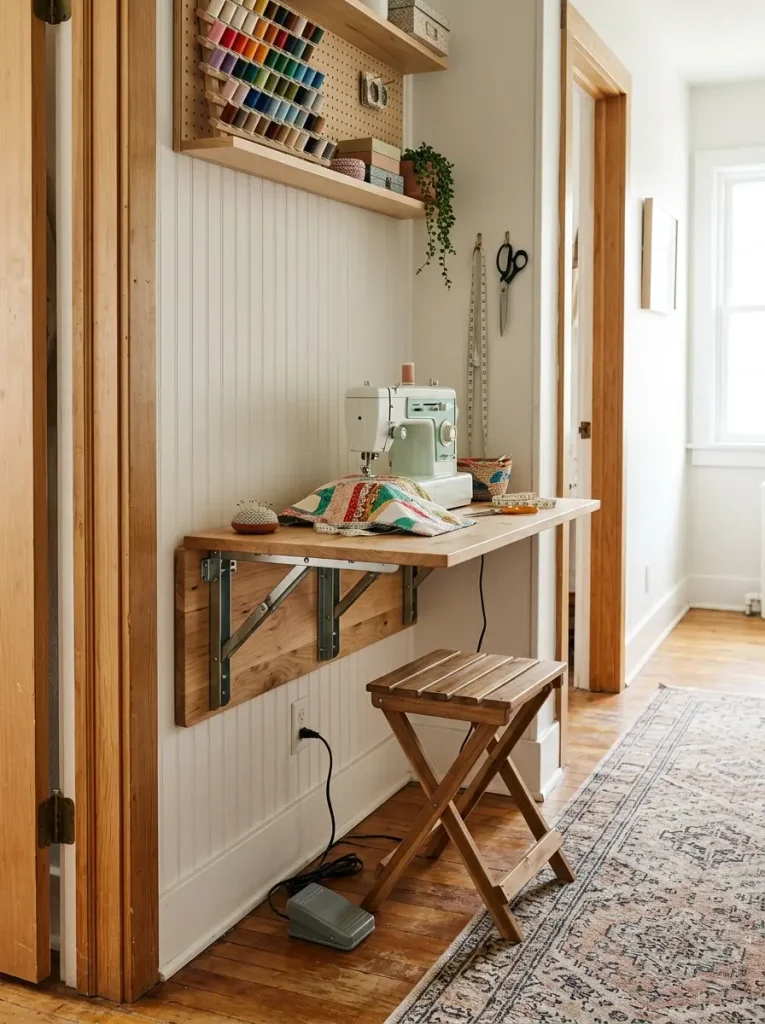
In rooms too small for a permanent table, a hinged wall mounted surface folds flat against the wall when not in use and drops down to full table height in seconds.
A simple support leg or bracket holds it steady while sewing, and folding it back up afterward reclaims the entire floor for other purposes.
Paired with a slim shelf above for thread and tools, this setup fits into a closet, a landing, or even the corner of a shared bedroom. It proves that lack of square footage doesn’t have to mean giving up a dedicated place to sew.
drops down to work, folds flat when done
21. Thread Wrapped Clothespins
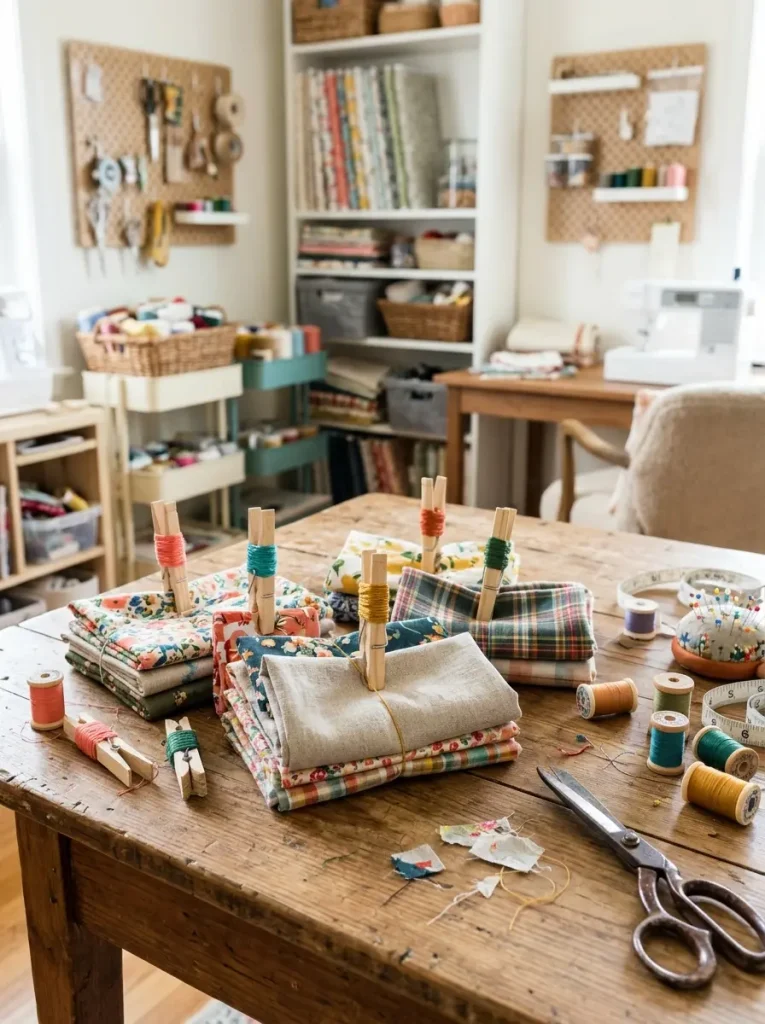
A small but satisfying detail, this idea uses plain wooden clothespins wrapped at the top with scraps of leftover thread to mark fabric bundles, pattern envelopes or UFO projects still waiting to be finished.
Each color wrap signals a different category, so a quick glance tells you what’s inside a stack without opening it.
The wrapping itself takes only a few minutes per clip and uses thread that would otherwise go unused. It’s a low cost way to bring a little more order into fabric stacks and bins that would otherwise blend together on a shelf.
22. An Entire Wall Devoted to Ribbon and Trim
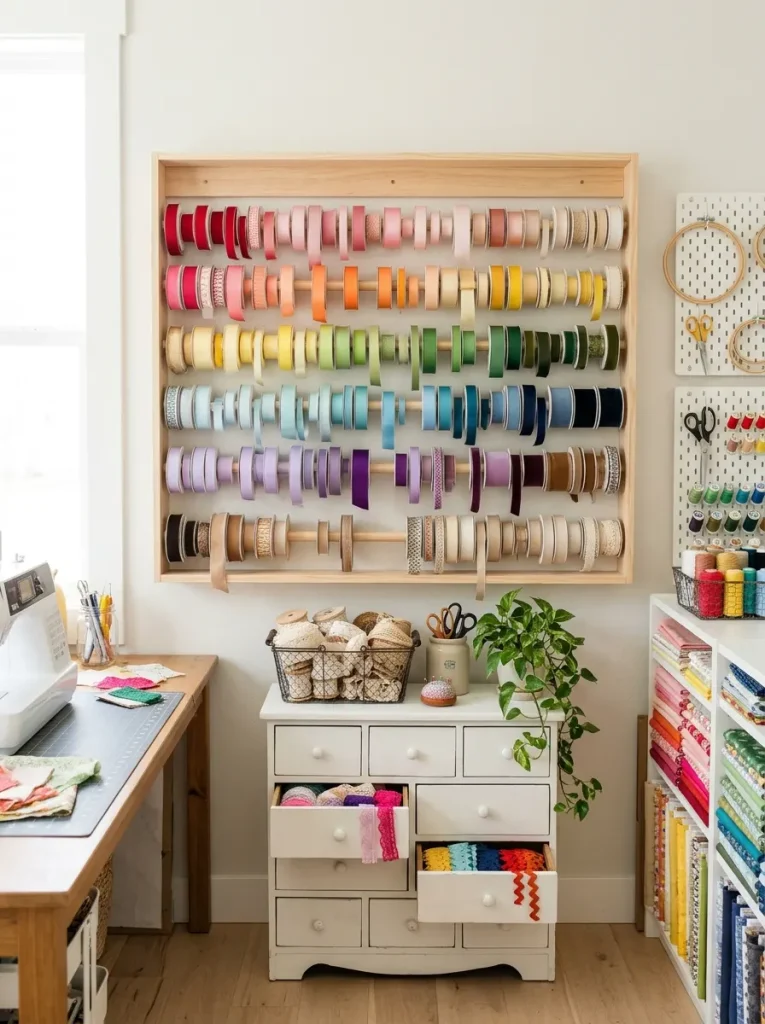
Dozens of ribbon spools mount on dowel rods set into a shallow wall frame, creating a display where every trim stays visible and easy to pull by just the right length. Grouped loosely by color, the wall becomes a soft gradient of its own without any extra effort.
A small drawer unit below holds trims too delicate or narrow for the dowels, like lace and rickrack. For anyone who works with ribbon often, mounting it this way beats digging through a drawer every time, and it turns a purely functional need into one of the room’s most colorful features.
ribbon mounted on dowels, grouped by color
23. A Reading Nook Tucked Beside the Sewing Table
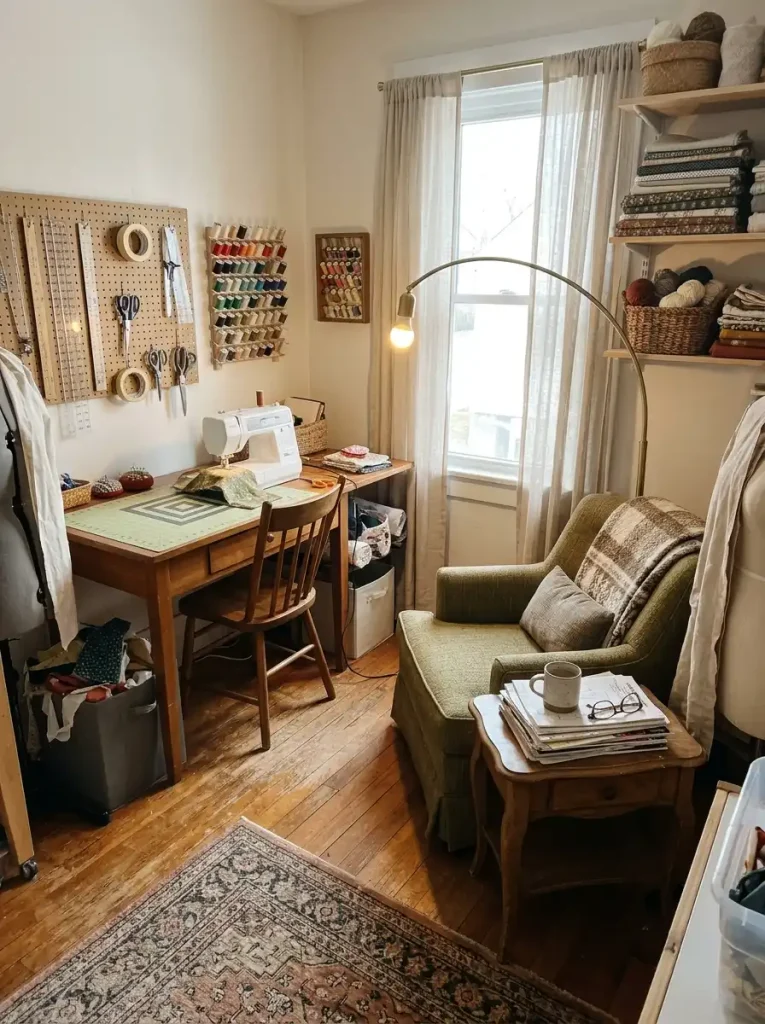
Not every corner of a sewing room needs to hold supplies. Here, a small armchair and side table sit just off the main work area, giving a spot to rest, flip through a pattern book, or wait out a long press with the iron.
A floor lamp arches over the chair for reading light that doesn’t compete with the task lighting at the machine.
This kind of pause space is easy to overlook when planning a craft room, but having somewhere to sit that isn’t the sewing chair keeps the room feeling livable instead of purely functional.
24. Chalkboard Labels for a Changeable Bin System
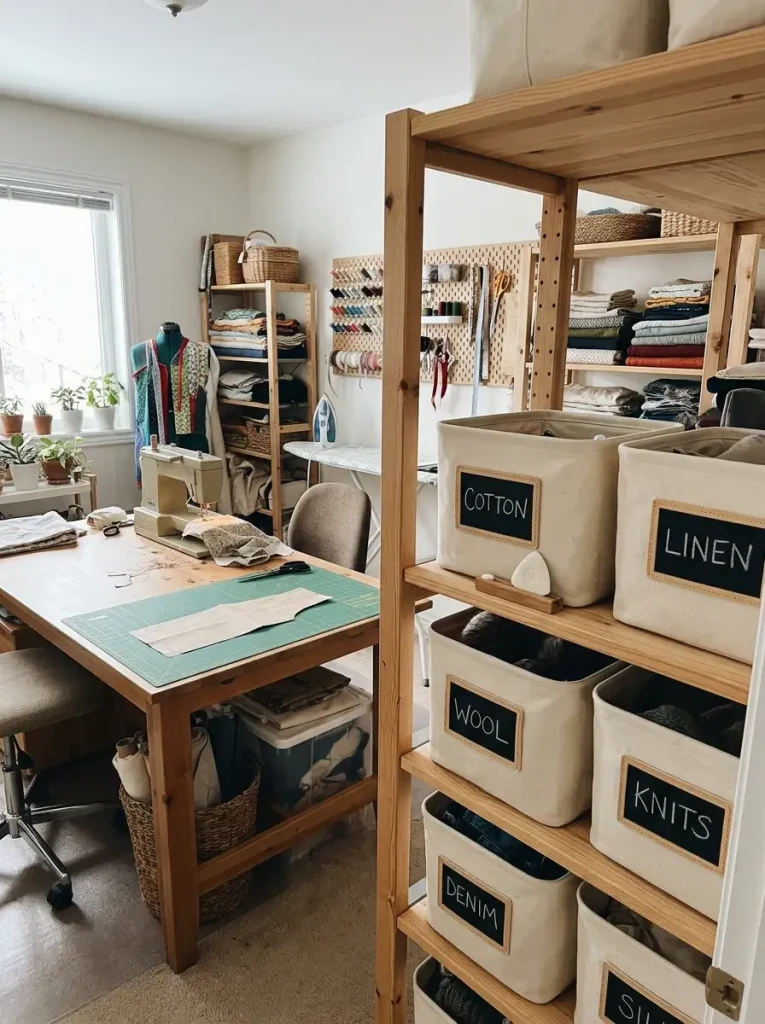
Plain storage bins get a small chalkboard label panel on the front, letting contents change without needing new printed tags every time a category shifts.
One bin might read fleece this month and flannel the next, updated with a quick wipe and a few words of chalk. This flexibility suits sewists whose fabric stash changes often with the seasons or current projects.
Paired with simple canvas or wicker bins, the chalkboard detail adds a small handmade touch while keeping the whole system genuinely useful instead of just decorative.
25. A Design Wall Made From Felt-Covered Foam Board
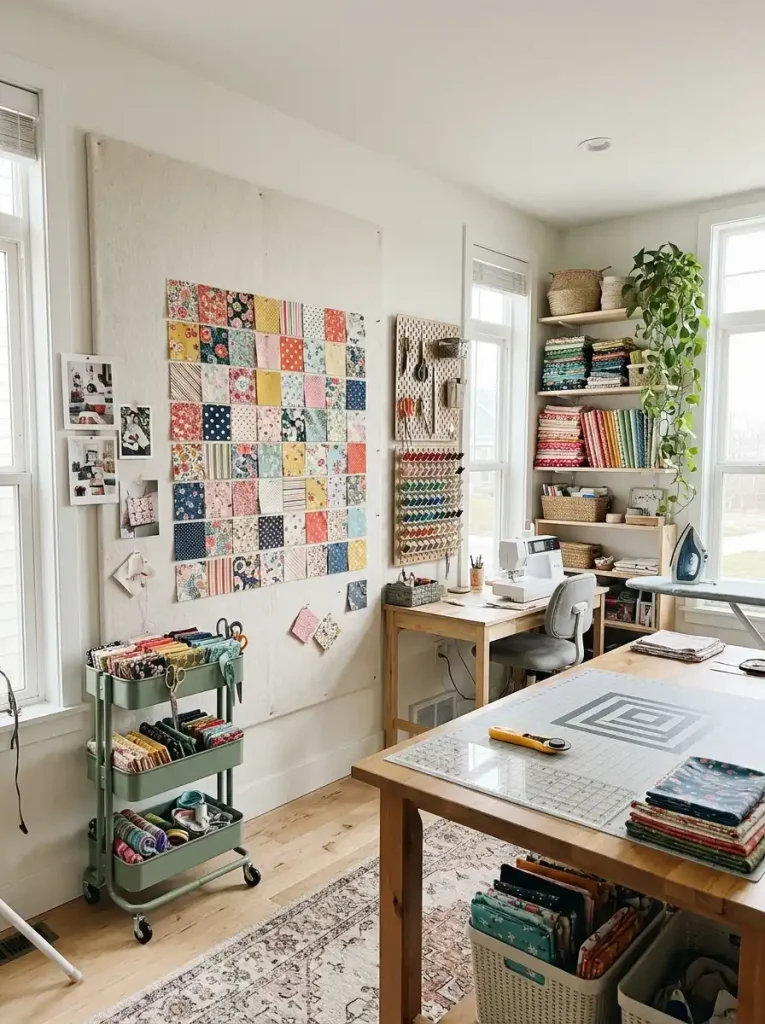
Large sheets of foam board wrapped in neutral felt and mounted vertically give quilters and garment sewers a place to arrange fabric pieces before stitching, since the felt’s texture holds pieces in place without pins.
Stepping back from the wall reveals the whole layout at once, making it far easier to catch spacing or color issues than working flat on a table.
The board can lean against a wall or mount with cleats for a more permanent setup. For anyone piecing anything larger than a single block, this simple build solves a problem most sewing rooms don’t think to plan for until it’s needed.
Conclusion
From pegboard walls to felt covered design boards, these 25 sewing room ideas show just how many directions a sewing space can take.
Some solutions cost almost nothing, like mason jars on a windowsill or chalkboard labeled bins, while others call for a bigger project, like converting a closet or building a fold down table.
What ties them together is intention, every detail here earns its place instead of sitting around as clutter.
Take what fits your space and your workflow, skip what doesn’t, and let your sewing room grow into something that actually makes you want to sit down and start stitching.